LLM01 Prompt injection
Content from emails, documents, and web pages is treated as data, not instructions. An agent cannot take a high-impact action because untrusted content asked it to.
Security and governance
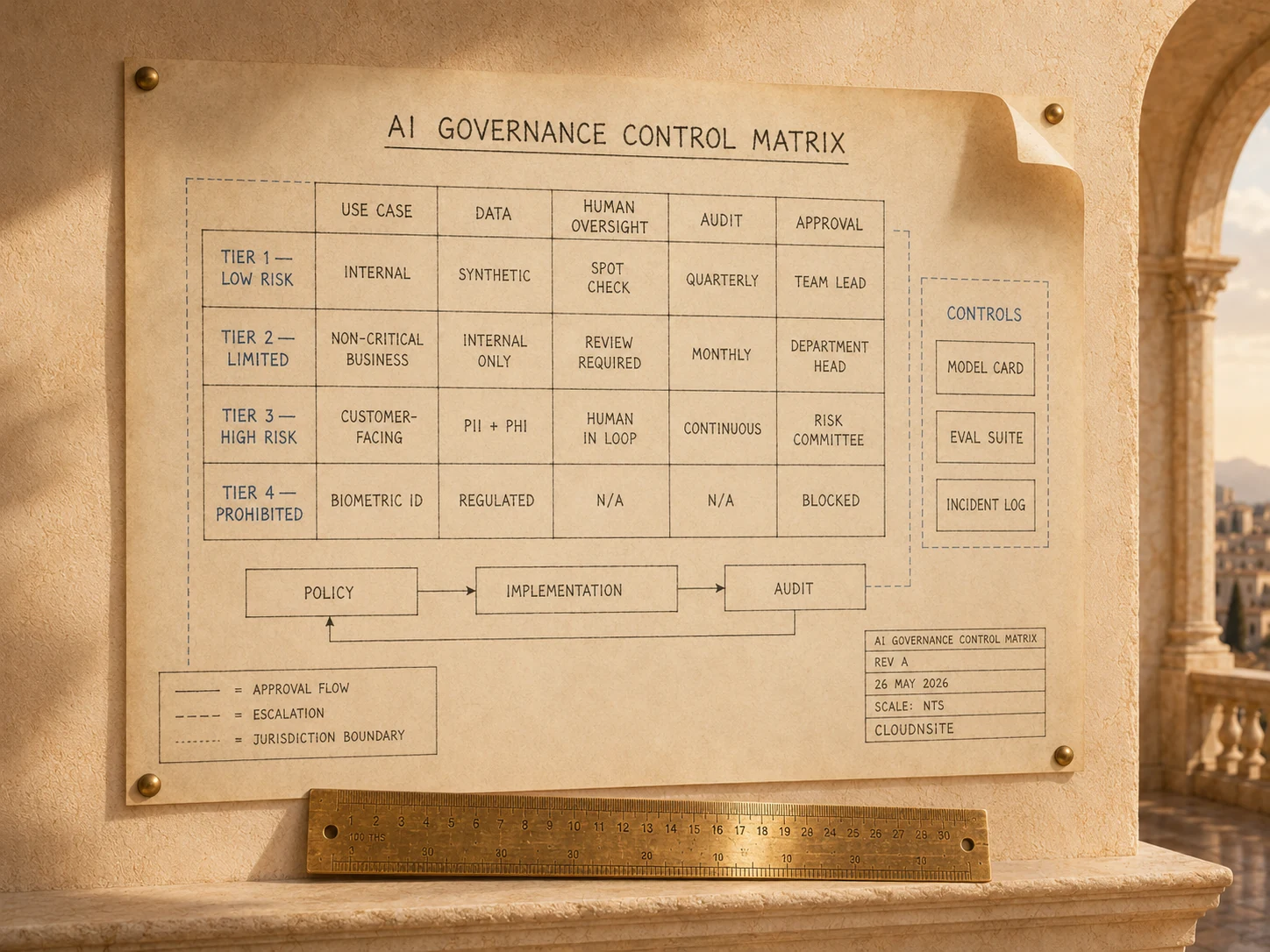
CloudNSite designs and builds AI agents against the NIST AI Risk Management Framework and the OWASP Top 10 for LLM Applications. Our team brings 25+ years of security and DevOps work, and security is part of how we design an agent from the first scope, not a review at the end. This page shows what that means in practice.
See the NIST mappingThe NIST AI Risk Management Framework organizes AI risk work into four functions. This is how each one shows up in the way we build.
| NIST function | What it asks | How we build |
|---|---|---|
| Govern | Accountability, policies, and roles | Each agent has a named business owner, a written list of allowed actions, and change control for releases. |
| Map | Context, intended use, and impact | The Current State Assessment documents the workflow, the data the agent touches, and what a failure would affect, before any build work. |
| Measure | Testing, evaluation, and monitoring | A defined acceptance test before launch, evaluation suites for operations-scale builds, and monitoring and exception logs after launch. |
| Manage | Responding to and reducing risk | Human approval at named decision points, a defined exception path, and a rollback plan for each release. |
The OWASP Top 10 for LLM Applications lists the most common ways LLM systems fail. These are the risks that matter most for agents that act inside business systems.
Content from emails, documents, and web pages is treated as data, not instructions. An agent cannot take a high-impact action because untrusted content asked it to.
Agents reach only the data their workflow needs. Redaction, private model deployment, and HIPAA or SOC 2 controls are scoped in where they apply.
Models and dependencies are pinned, and an upgrade is reviewed and tested before it reaches production.
Least-privilege access and an explicit list of allowed actions for each agent. Anything outside that list goes to a human.
Consequential outputs carry their source references and pass through human sign-off at named points.
Rate limits and spend caps on model usage, so a loop or an abusive input cannot run up cost or exhaust capacity.
This page describes how we design and build. It is not a certification or a compliance claim. Which controls apply to your workflow, and how each one is evidenced, is set in writing during the Current State Assessment or the AI Initiatives Review.
Book a free 30-minute AI Strategy Call. Bring your security questionnaire and we will walk through it with the engineers who would build the agent.
Book an AI Strategy Call