Security-First Deployments
AI Voice Agents for Inbound Calls, Scheduling, and Qualification
CloudNSite builds and operates AI voice agents that pick up inbound calls 24/7, qualify the caller, book appointments, route urgent issues to a human, and write context-aware notes into your CRM, EHR, or service desk. Real-time speech, named-entity capture, evaluation harness, ongoing tuning. Live in 4 to 6 weeks.
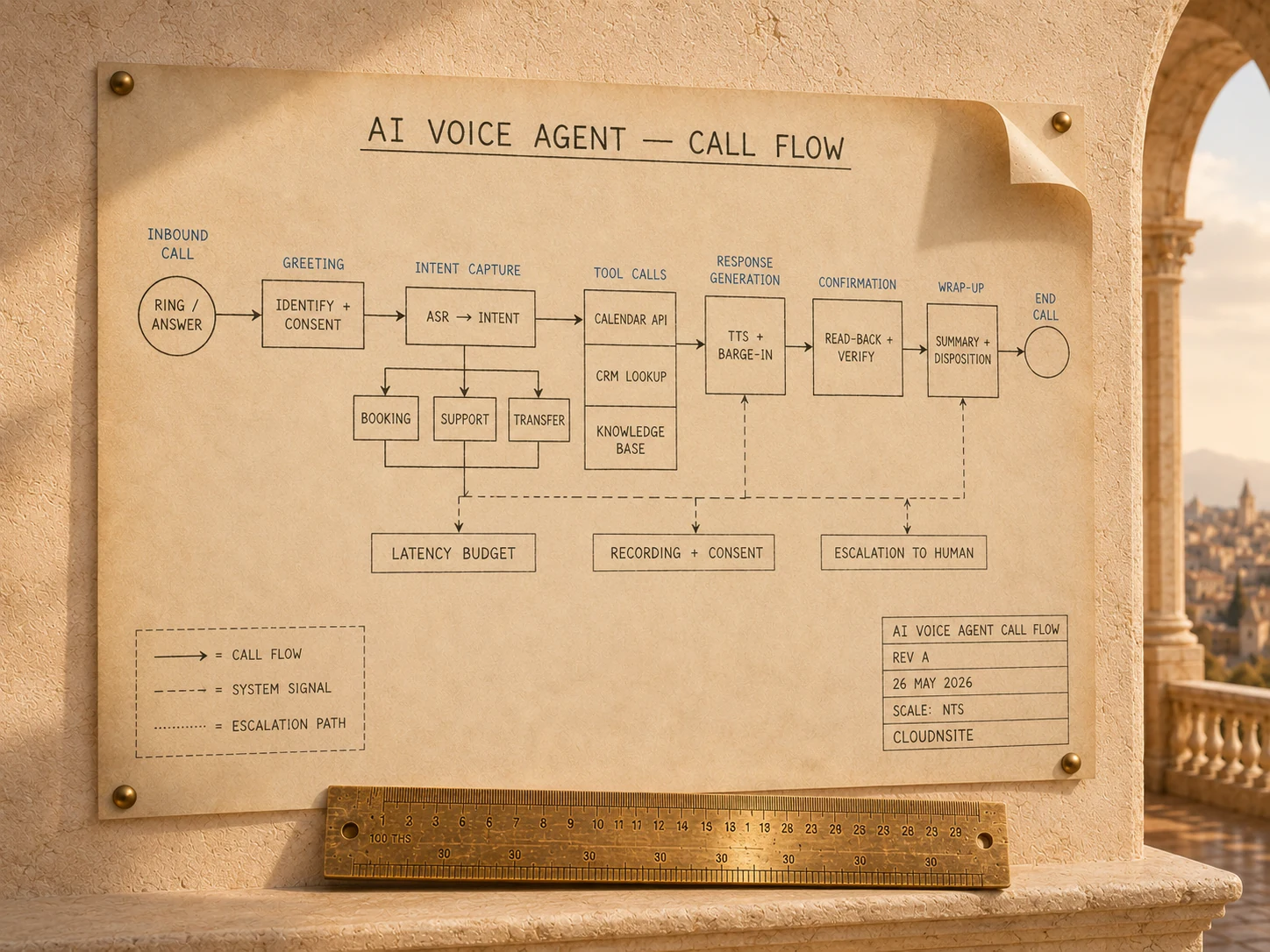
System diagram
Pain Points
Inbound calls die in voicemail
Missed calls are missed pipeline. After-hours and lunchtime calls go to voicemail and never come back. A voice agent handles the call live, captures intent, and books or routes immediately.
Front-desk staff are stuck on phones
Receptionists, dental staff, intake coordinators, and shop schedulers burn 4 to 6 hours a day on inbound calls that follow the same patterns. A voice agent absorbs the routine traffic and routes the exceptions.
Touch-tone IVR drops callers
Interactive voice response forces the caller to navigate menus and still hands off to a queue. A voice agent has a natural conversation, captures intent on the first sentence, and handles the request end to end.
Outbound voicemail returns are slow
Speed-to-lead beats sequencing. A voice agent can call back web form leads within seconds, qualify them, and book the meeting on the calendar of the right rep.
Multilingual demand goes unanswered
English-only phone trees lose Spanish-speaking and bilingual callers. A voice agent answers in the caller's language and writes a single-language transcript into the CRM.
How Our Agents Solve This
AI Receptionist
Greets inbound calls 24/7, identifies the caller, captures the reason for the call, books or routes per business rules, and writes a structured note into the CRM, EHR, or PSA.
Appointment Scheduler
Reads availability from the calendar of record (Google, Outlook, Acuity, NexHealth, Calendly, Athenahealth scheduling), proposes times, and confirms the booking with the caller in conversation.
Lead Qualifier
Asks the qualification questions your team uses today, scores the lead, books a meeting if qualified, and routes the unqualified ones to a nurture path with a transcript attached.
Outbound Speed-to-Lead Caller
Calls inbound web form leads within seconds of submission, qualifies, books a meeting, or sends a calendar link if the caller cannot talk live.
Service Dispatcher
Captures the issue (HVAC, plumbing, IT, property maintenance), pulls the customer record, scores urgency, books a service window, and pages the on-call human when the issue is critical.
Multilingual Front Desk
Detects the caller's language at hello, runs the entire conversation in English or Spanish, and writes the note back in your team's working language.
Expected Results
How Implementation Works
- 1
Discovery and call-flow audit
We listen to recorded calls with consent, document the existing flow, identify the routine traffic the voice agent should absorb, and pin the exception paths that must reach a human.
- 2
Voice and dialog design
Brand voice, refusal patterns, escalation rules, and the conversation structure are written before any audio model is wired in. We select speech-to-text, text-to-speech, and dialog model based on latency and language needs.
- 3
Integration build
Wire to the systems of record (CRM, EHR, calendar, service desk), set tool-level permissions, build the structured-note template, and instrument the pipeline with call recording, transcript capture, and OpenTelemetry traces.
- 4
Evaluation harness and dry run
Run the voice agent against recorded fixtures and a calibration set of live test calls. Score on accuracy, handoff correctness, and brand voice. Production cutover is gated behind a passing scorecard.
- 5
Cutover and ongoing tuning
Forward a single number or queue to the voice agent first, watch live calls, expand to additional numbers once stable. CloudNSite continues to monitor, tune the dialog, and ship updates.
Related Blog Posts
AI Receptionist Pricing in 2026: What It Actually Costs
Read article
AI Answering Service vs. Human: Which Should Handle Your Calls?
Read article
AI Appointment Scheduling Automation
Read article
AI Agent vs Chatbot: Which Does the Work
Read article
AI Agents for Dental Practices in 2026
Read article
AI Automation vs Virtual Assistants
Read article
Related Guides
Explore
How to Switch from Manual Workflows to AI Agents
Switch from manual workflows to AI agents with a practical rollout plan. Identify first automations, expected ROI, timeline, and change management steps.
Explore
Alternatives to Generic Chatbots for Business Operations
See alternatives to generic chatbots for business operations. Compare scripted bots with AI agents that run workflows, connect systems, and take action.
Explore
Best AI Agents for Small Medical Practices
Compare the best AI agents for small medical practices with 1-10 providers. Learn costs, staffing impact, and HIPAA-ready setup without internal IT teams.
Frequently Asked Questions
Does an AI voice agent sound robotic?
Modern text-to-speech models we use are indistinguishable from a human voice for most callers. We tune cadence, brand voice, and refusal patterns for your operation. Callers are told they are speaking with an AI assistant when your policy or local law requires disclosure.
What happens when the caller has an issue the voice agent cannot handle?
The voice agent escalates to a human with full conversation context. For urgent issues (medical emergencies, plumbing leaks, fraud) the escalation is immediate. For non-urgent exceptions the agent books a callback or routes to the team's standard queue.
How does the voice agent integrate with our CRM, EHR, or service desk?
Through approved APIs and integrations. We have shipped against HubSpot, Salesforce, Athenahealth, eClinicalWorks, NexHealth, ServiceTitan, Jobber, and others. Each integration uses scoped credentials and per-call authorization.
Is the voice agent HIPAA-ready for medical practices?
Yes. We deploy voice agents inside a BAA-covered architecture for healthcare, with call recording, transcript storage, and downstream system access under HIPAA-compliant controls. Disclosure is configured per state and per practice policy.
Can it handle Spanish-speaking callers?
Yes. The voice agent detects the language at hello and runs the entire conversation in English or Spanish. Notes are written back in your team's working language so the front-desk team does not need to be bilingual to read them.
How long does an AI voice agent build take?
Most voice agent builds follow the typical 4 to 8 week delivery window; complex telephony or EHR integrations can run toward the longer end.
How is this different from RingCentral, Five9, or Genesys voice AI features?
Call platform voice AI features are template-driven and tied to the platform. CloudNSite builds and operates a voice agent that integrates across your real systems, follows your specific call flows, and ships with an evaluation harness rather than a pre-built script.
Who maintains the voice agent after launch?
CloudNSite. We build, operate, and tune the voice agent. Dialog updates, integration changes, and model upgrades are part of the ongoing engagement, with monthly call review and accuracy scoring.
Is an AI voice agent the same as an AI answering service?
Yes. What gets marketed as an AI answering service or AI receptionist is the same underlying system as an AI voice agent: it answers inbound calls, understands intent, resolves what it can on the call, and hands off to a human with full conversation context when it can't.
Ready to Fix This Workflow?
Plan an AI Voice Agent Build. Plan a custom build for this workflow or run the AI readiness check for a fast baseline.