Technical guide from CloudNSite engineering
Generative Engine Optimization for AI Overviews and LLM Answers
Generative engine optimization (GEO) and answer engine optimization (AEO) are not classic SEO with a new name. CloudNSite ships the content shape, structured data, discovery files (llms.txt, ai-search.json), and citation hooks that put your pages inside AI Overview answers, Perplexity citations, ChatGPT browsing results, and Claude responses. Honest scope, measurable wins, no growth-hack vendor pitch.
System diagram
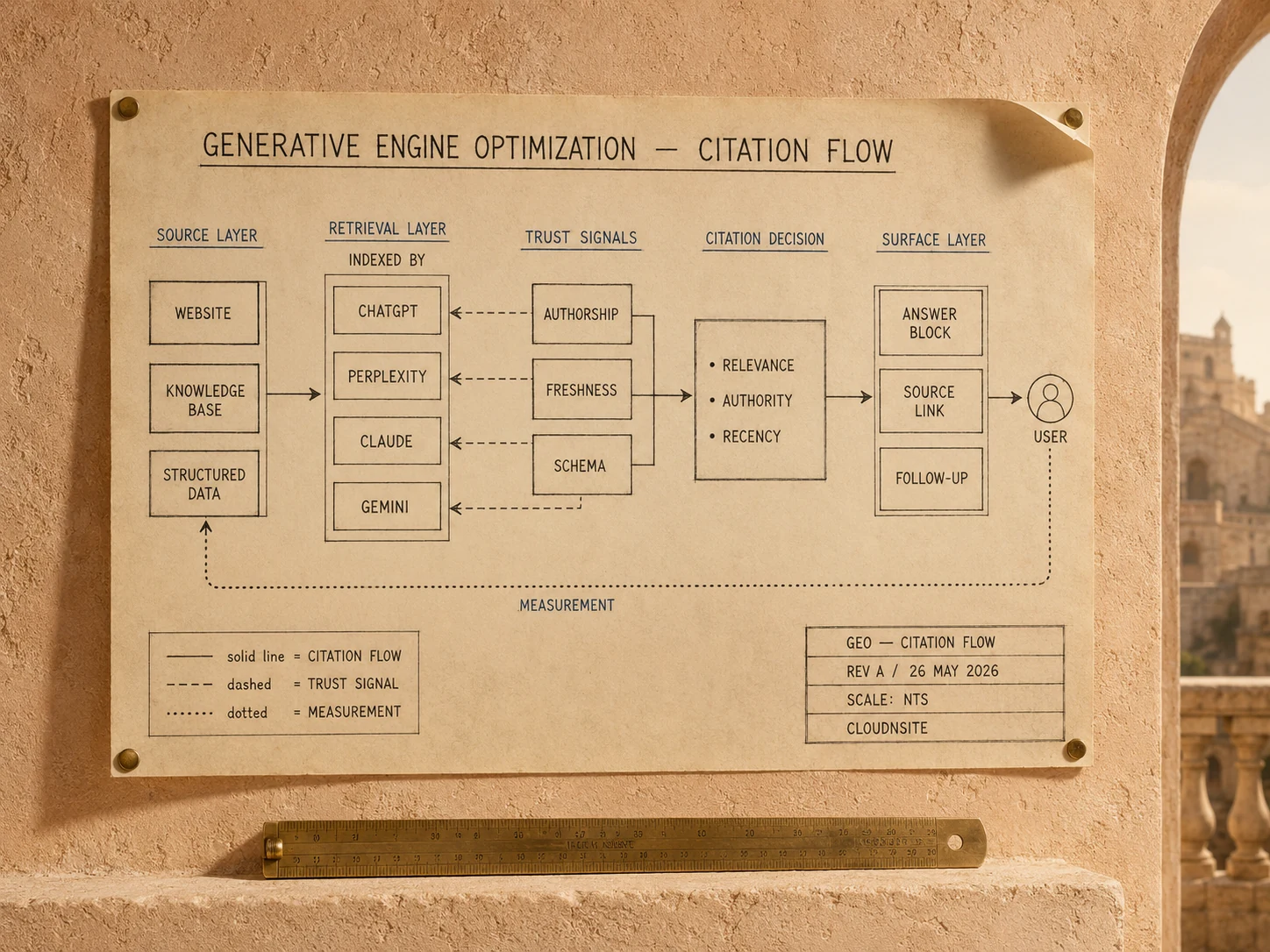
Direct answer
Generative engine optimization (GEO) is the practice of shaping content, structured data, and discovery files so that generative search systems (Google AI Overviews, Perplexity, ChatGPT, Claude) cite the page in their answers. It overlaps with classic SEO on technical hygiene, but the winning shape is different: direct answers, named entities, structured FAQs, and machine-readable discovery files.
Key definitions
- AI Overview
- Google Search's generative answer that appears above the classic blue-link results for many queries. Cites a small set of source pages with linked attribution. The number-one prize for most GEO work in English-speaking markets.
- Answer engine optimization (AEO)
- The earlier name for what most teams now call GEO. AEO emphasizes the answer-engine shape: a direct, scannable answer near the top of the page that an LLM can lift verbatim. GEO is broader and includes discovery and structured signals.
- LLM citation
- An attributed reference to a page inside a generative answer. Different surfaces format citations differently (inline footnotes, source pills, link cards), but the underlying signal is the same: the model chose your URL as a source.
- llms.txt
- Plain-text discovery file at /llms.txt and /llms-full.txt published by sites that want to help LLMs find their canonical content. Spec proposed by Jeremy Howard in 2024 and adopted by a growing set of documentation, framework, and product sites.
- ai-search.json
- Machine-readable index of canonical pages with summary, intent, and citation-ready fields. Used by some retrieval systems and by site-owners to expose what they want surfaced. Not yet a formal standard.
Six layers of a working GEO program
GEO is six interlocking layers on top of classic SEO hygiene. Skipping a layer rarely produces citations. CloudNSite ships all six and instruments each one so we can attribute wins to the layer that produced them.
Page content shape
Direct answer near the top (40 to 60 words), definition block, structured comparisons, named entities, and a FAQ at the bottom. The page must read as an answer, not a brochure.
Structured data
Schema.org markup for the page type (Article, TechArticle, Service, FAQPage, HowTo) plus BreadcrumbList and Organization. Validated against Google's Rich Results Test and Schema.org's validator on every deploy.
Discovery files
/llms.txt and /llms-full.txt published at the site root, plus an ai-search.json index. Sitemap.xml stays canonical. The discovery files give LLMs and retrieval crawlers a fast path to the canonical content.
Citation hooks
Named entities (people, organizations, products), version pins, dated examples, and quotable one-liners. LLM citation systems prefer pages that are easy to attribute and hard to confuse with another source.
Internal linking and pillar structure
Pillar pages with topical depth, supported by cluster blog posts that link in. Generative systems reward the same authority signals as classic SEO, often more strongly.
Monitoring and attribution
Track AI Overview presence per query, Perplexity citation share, GSC click-through changes, and brand mention volume in third-party LLM logs where available. Real measurement, not vibes.
When to use this
- You publish content that already ranks classically but is not being cited in AI Overviews or LLM answers.
- Your category has visible AI Overview presence (most B2B and consumer queries do as of 2026) and you have zero or near-zero presence in those answers.
- You are launching new content and want it shaped for AI surfaces from day one rather than retrofitting later.
- You have a developer documentation or product surface where llms.txt and an ai-search.json index materially help adoption.
- Your customers describe finding competitors through ChatGPT, Claude, or Perplexity, and you are missing from those answers.
When not to use this
- Your classic search hygiene is broken. Fix indexing, canonicalization, and Core Web Vitals before chasing GEO citations.
- You sell into a category with no AI Overview presence and no AI assistant query volume. The pages still benefit from structured content, but the GEO label is the wrong frame.
- A vendor is pitching a guaranteed AI Overview ranking. Walk away. Nobody can guarantee citation share.
How CloudNSite implements it
- 1
Audit current AI surface presence
Run a curated query set across Google AI Overviews, Perplexity, ChatGPT browsing, and Claude. Document where the brand appears, where competitors appear, and what content shape is being cited. The audit is the baseline against which all later changes are measured.
- 2
Reshape the top-priority pages
Add a direct-answer block near the top, restructure into definition plus architecture plus FAQ shape, name the entities, pin the versions, and clean the structured data. The pages must read as answers to the queries that matter.
- 3
Publish discovery files and clean the schema
Generate and publish /llms.txt, /llms-full.txt, and ai-search.json. Validate every schema block against the rich results test. Wire sitemap.xml correctly and remove stale entries.
- 4
Build the supporting cluster content
Ship the 4 to 6 supporting blog posts that link into each pillar, with the same direct-answer plus FAQ shape and clean structured data. Cluster authority is a strong generative signal.
- 5
Monitor citations and tune cadence
Track AI Overview presence per query weekly, log Perplexity citations, watch GSC click-through changes, and tune the content as the surfaces evolve. CloudNSite operates the monitoring and content tuning alongside the editorial team.
Tools and standards we use
llms.txt proposal
Plain-text discovery file proposed by Jeremy Howard in 2024. Two files: /llms.txt (short index) and /llms-full.txt (full canonical content).
Schema.org
Article, TechArticle, Service, FAQPage, HowTo, BreadcrumbList, Organization. Validated on every deploy.
Google Search Console + IndexNow
GSC for AI Overview impressions and click-through, IndexNow for fast notification to Bing and partner crawlers.
Curated query set, run weekly against AI Overviews and major LLM products
There is no clean API for AI Overview presence. We build and run the query set as a measured workflow with stored screenshots and citation extraction.
robots.txt + LLM crawler allow-list
Explicit decisions on which LLM crawlers (GPTBot, ClaudeBot, PerplexityBot, Google-Extended) are allowed, blocked, or rate-limited. Documented and version-controlled.
Rich Results Test, Schema.org validator, lighthouse SEO audit
Pre-deploy gates so structured data never ships broken.
From the field
CloudNSite's own GEO surface
cloudnsite.com publishes /llms.txt, /llms-full.txt, llms.es.txt, and an ai-search.json index. Every solution and expertise page ships with direct-answer blocks, FAQ schema, and a TechArticle or Service schema block. The same pattern we ship to clients is the pattern this site uses.
Read the full case studyFrequently asked questions
Is GEO the same thing as SEO with a new name?
No. GEO and SEO share technical hygiene (clean indexing, canonical URLs, structured data, internal linking), but the content shape that wins generative citations is different. Direct answers near the top, named entities, version pins, and machine-readable discovery files matter more for GEO than for classic ranking.
Does publishing llms.txt actually help?
Direct evidence is still limited. Some retrieval systems do read llms.txt and prefer the canonical content it points to. The cost of publishing is low and the file also serves as a living index for the engineering team. Treat it as low-cost hygiene, not a guaranteed citation lever.
Should we block GPTBot, ClaudeBot, and PerplexityBot?
Depends on your business. Blocking removes your content from the training and retrieval pools that produce citations. Allowing exposes content to model training without compensation. We help map the trade-off per content type (product pages, docs, paywalled research) and document the decision in robots.txt.
How long until we see citation wins?
Page-level changes typically show up in AI Overview reshuffling within 2 to 6 weeks. Cluster-level wins (where a pillar plus its supporting posts start appearing together) usually take 8 to 16 weeks. There is no shortcut and anyone promising one is selling fluff.
How do we measure GEO success?
AI Overview presence per priority query, Perplexity citation share, GSC click-through changes on queries with visible AI Overviews, and brand mention volume in third-party LLM logs where available. We report against a baseline taken at the start of the engagement.
Does this conflict with our existing SEO program?
It should complement it. GEO depends on a working SEO foundation. We coordinate with the existing SEO team or agency so content briefs, internal linking, and structured data work do not duplicate or contradict.
Will Google AI Overviews send us less traffic?
Some queries lose a click and some gain one. The pattern depends on the query and the answer surface. We track click-through changes on AI Overview queries and report the actual movement rather than projecting from industry averages.
Who runs the GEO program after CloudNSite ships it?
CloudNSite. We build the discovery files, structured data, content shape, and monitoring, then continue to tune as surfaces and citation patterns evolve. Editorial work stays with the team that owns the voice.